
SEO vs AEO vs GEO is the wrong question. Modern search has five systems that work together: SEO gets you found on Google, AEO makes you the direct answer, GEO gets you recommended by AI assistants, AIO makes your pages readable by AI tools and SXO makes visitors choose you once they arrive. Most of the work behind them is shared, so the job is to plan them as one programme, not five.
This guide explains each system in plain terms: what it is, the parts that make it work, what to track and the mistakes we see most often. It uses current data from Google, Ahrefs, Pew Research and others, updated for what changed in 2026, so you can decide where your time and budget should go in 2027.
Why SEO on its own no longer covers search
For twenty years, search optimisation had one job: rank a page on Google and win the click. That job still matters. What changed is that the click is now the last step of a longer journey. Several of the earlier steps happen without your website.
A buyer might ask ChatGPT for a shortlist of providers, check two names in Google, read an AI Overview that quotes a competitor's pricing page, look at reviews on their phone and only then visit a website. Each of those moments is decided by a different system. Ranking well helps with some of them and does nothing for others.
The numbers show the shift. Ahrefs compared December 2023 with December 2025 across 300,000 keywords and found that an AI Overview cut the click-through rate of the number one result by about 58%. SparkToro and Datos found that 58.5% of US Google searches in 2024 ended without a click at all. Seer Interactive saw a partial rebound in early 2026, but the direction is clear: being seen and being clicked are no longer the same thing.
That is why the industry has started using new names: answer engine optimisation (AEO), generative engine optimisation (GEO), AI optimisation (AIO) and search experience optimisation (SXO). The labels are useful when they help you see a gap. They are harmful when they turn into five separate projects, five reports and five suppliers working on the same pages.

Where this framework comes from and what we changed
A "modern SEO cluster" infographic with five systems and 31 parts has been shared widely online. It is one of the clearer pictures of how search works now. It inspired this guide. Some of its parts have aged in the last year, so we have updated them:
- Voice answers have changed handsGoogle began removing Google Assistant from Android phones on 4 September 2026 and replacing it with Gemini. Spoken answers now come from the same AI models as AI Mode, so voice is part of AEO and GEO rather than a separate track.
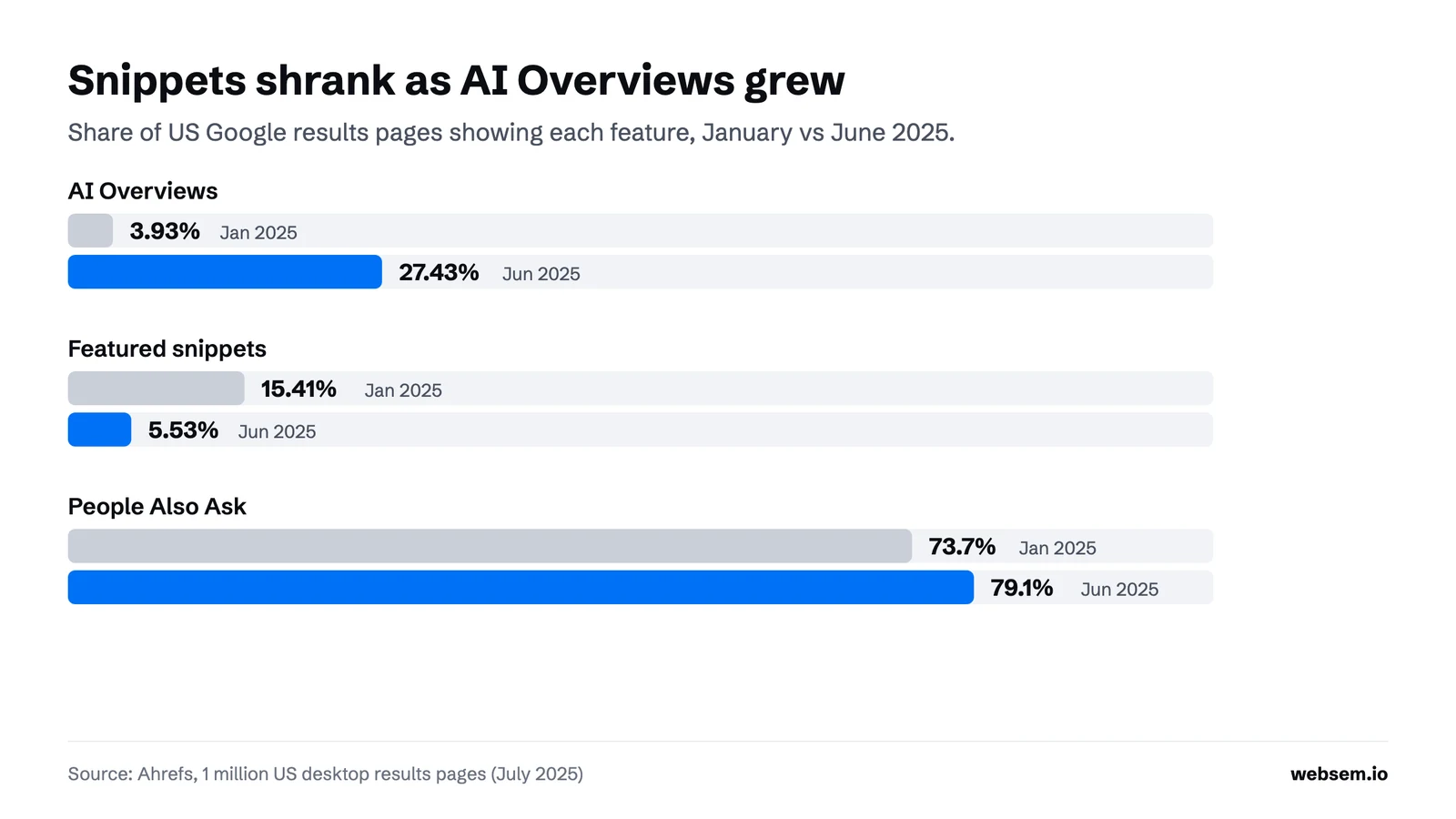
- Featured snippets are shrinkingAhrefs measured snippets on 15.41% of US results pages in January 2025 and 5.53% in June 2025, while AI Overviews rose from 3.93% to 27.43%. Snippets still exist, but the answer box is now usually an AI Overview.
- FAQ rich results are goneGoogle stopped showing FAQ rich results on 7 May 2026. FAQ sections are still worth writing for readers and AI tools, but they no longer earn a search feature.
- "AIO" means two thingsMany people use AIO as shorthand for Google's AI Overviews. In this framework it means AI optimisation: making sure AI tools can fetch, read and trust your pages. We use it in that second sense.
- AI agents belong in two placesPages that AI agents can use (to compare, book or buy) are partly a readability job (AIO) and partly an experience job (SXO). We cover both.
The structure below follows the five systems. For each one you will find what it is, the parts that make it work, what to track and the most common mistake.
1. SEO: found on Google
Search engine optimisation (SEO) is the work that makes your pages show up in Google's results, Maps and Discover for the searches your buyers make. It is still the foundation of everything else. Google's AI features pull from Google's index, so a page that is not indexed or trusted cannot be quoted in an AI Overview either.
The link between ranking and AI visibility has loosened, though. In Ahrefs' March 2026 study of 863,000 results pages, about 38% of AI Overview citations came from pages in the top 10 and 31% came from pages outside the top 100. Google builds AI answers from many related searches, so broad topic coverage now counts as much as one strong ranking.
Technical health
Search engines need to crawl your pages, render them and add them to the index. Check the Pages report in Google Search Console for important pages marked "Crawled, currently not indexed" or "Excluded by noindex tag", fix broken redirects and keep your XML sitemap clean. Technical problems are the cheapest to fix and the most expensive to ignore, because they block every other system.
On-page basics
Every important page needs a title that matches the search, a meta description that earns the click, one clear H1 and headings that follow the questions people ask. Images need descriptive alt text. Internal links should point to your priority pages with anchor text that describes them.
Topic coverage
Cover a subject in depth, not in scattered posts. Map the questions buyers ask from "what is" to "how much" to "which provider", then build a main page with supporting articles that link to each other. This is what Google means by being helpful on a topic. It is also what feeds AI answers that run several searches at once.
Clear brand facts
Search engines need to know who you are: your business name, what you do, where you work and who is behind the content. Put that on an About page, in author bios and in Organization or LocalBusiness schema that links to your official profiles.
Backlinks and mentions
Links from relevant, trusted sites still tell Google that your pages deserve to rank. Mentions of your brand without a link matter more than they used to, because AI tools read the web as text. Digital PR, expert commentary and original data earn both.
Local SEO
For any business with a service area, the Google Business Profile is often the first thing a buyer sees. Keep categories, services, hours and photos current, post updates and answer every review. Make sure your name, address and phone number match on your website and every directory.
What to track: rankings for your priority searches, clicks and impressions in Search Console and organic leads in Google Analytics.
Common mistake: treating SEO as finished once the site ranks. Pages lose ground as competitors update theirs. A page that slips from position 3 to 9 also becomes less likely to be quoted in AI answers.
2. AEO: the direct answer
Answer engine optimisation (AEO) is the work that makes your content the answer, not just a link near it. It covers AI Overviews, People Also Ask boxes, the remaining featured snippets and spoken answers from Gemini. The goal is that when someone asks a question in your field, the answer they read uses your words and names your business.
Answer-first pages
AI answers quote passages, not whole pages. Put the answer in the first one or two sentences under each heading, then give the detail: numbers, steps, conditions and examples. A buyer skimming the page gets the point at once. An AI tool looking for a quotable passage finds one.
Questions by persona and stage
A finance manager, a business owner and an IT lead ask different questions about the same product. Someone early in their research asks "what is"; someone close to buying asks "how long does it take" or "which is better". List the real questions for each buyer and stage from sales calls, support tickets, Search Console queries and People Also Ask, then make sure each one has a clear answer somewhere on your site.
FAQ sections
FAQ sections remain one of the easiest ways to answer follow-up questions on a page. Google no longer shows FAQ rich results, but the questions and answers are still read by Google, by AI assistants and by people. Keep each answer short, specific and consistent with the rest of the page.
People Also Ask
People Also Ask grew from 73.7% to 79.1% of US results pages in the first half of 2025, according to Ahrefs. The questions in those boxes are a free list of what people want to know next. Use them to plan headings and FAQs. Then check which sites currently own the answers.
Featured snippets
Snippets still appear for some searches and they reward the same writing style as AI Overviews: a direct definition, a short numbered list or a clean table. Write for that format and you serve both. Do not build a strategy around snippets alone.
Voice answers
With Gemini replacing Google Assistant on Android phones, spoken answers now come from Google's AI models. A page that gives a clear, short answer to a spoken-style question ("how long does a website redesign take?") is the same page that wins in AI Overviews. There is no separate voice checklist any more.
What to track: the questions where your page is quoted in an AI Overview or People Also Ask box. Track a fixed list of questions and check them every month.
Common mistake: writing a long introduction before the answer. If the answer is in paragraph four, an AI tool will quote someone who put it in paragraph one.
3. GEO: recommended by AI
Generative engine optimisation (GEO) is the work that gets your brand named and cited when people ask ChatGPT, Gemini, Perplexity, Copilot or Claude for advice or a recommendation. Where AEO is about the answer to a question, GEO is about the shortlist: which businesses the AI suggests when a buyer asks "who should I use?"
The term comes from a 2023 Princeton research paper, published at KDD 2024, which found that some changes to a page could raise its visibility in AI answers by up to 40%. Citing sources, adding quotations and adding statistics worked best. The finding has held up: AI tools favour content that looks like evidence.
AI citations
A citation is a link to your page inside an AI answer. Pages get cited when they state a fact clearly, back it up and are easy for the AI tool to fetch. Original data, clear definitions, comparison tables and step-by-step guides are cited most. Check which of your pages are cited today and which competitor pages are cited instead.
Mentions on trusted sites
AI assistants build their picture of a business from what other sites say about it. In Ahrefs' study of 75,000 brands, branded web mentions had a correlation of 0.709 with AI visibility and YouTube mentions 0.737, ahead of other signals they tested. Industry publications, news sites, association directories and comparison articles all count.

Reviews
Reviews give AI tools language to describe you and evidence that real customers are happy. BrightLocal's 2026 consumer survey found that 45% of consumers now use ChatGPT or other AI tools to find local business recommendations. Ask every happy client for a review on Google and the review sites in your industry. Then reply to every review.
Reddit, YouTube and LinkedIn
Community and video sites are among the most cited sources in AI answers. Peec AI's March 2026 analysis of 30 million sources ranked Reddit first, YouTube second, LinkedIn third and Wikipedia fourth across the main AI engines. Short, useful videos that answer buyer questions and honest participation in relevant communities give AI tools more to draw on. Spam in those communities does the opposite.
Same brand facts everywhere
If your website says you have offices in three cities, your LinkedIn page says two and an old directory listing says one, an AI tool has to guess. Keep your name, services, locations, founding year and description identical across your website, Google Business Profile, Bing Places, LinkedIn, directories and review sites.
Fresh content
AI assistants lean towards newer pages. Ahrefs found that pages cited by AI assistants were on average 25.7% fresher than pages in normal Google results, with ChatGPT showing the strongest preference. Review your most important pages on a schedule and update facts, figures and examples when they change.
Regular answer tracking
AI answers change from week to week. Write 30 to 50 prompts that your buyers would ask, run them across the main AI engines on a fixed schedule and record which brands are named and which pages are cited. Weekly tracking suits competitive markets; monthly suits most businesses. The cited sources become your to-do list.
What to track: how often your brand is named for your buyer prompts, which of your pages are cited and your share of mentions against named competitors.
Common mistake: chasing mentions with thin guest posts or paid listicles. AI tools weigh trusted, relevant sources; a mention on a site nobody reads adds little.
4. AIO: readable by AI
AI optimisation (AIO) is the technical layer under AEO and GEO. It makes sure AI tools are allowed to fetch your pages, can read the text and can understand what each page is about. If this layer fails, the best-written page on the web is invisible to them.
Crawler access
Each AI company runs several crawlers with different jobs. Blocking the wrong one can remove you from AI answers without you noticing. Check robots.txt and, just as important, your firewall or bot protection: Cloudflare has blocked AI crawlers by default for new customers since July 2025. Some security plugins block every automated visitor.
| Crawler | Company | What it does | If you block it |
|---|---|---|---|
| OAI-SearchBot | OpenAI | Finds pages for ChatGPT search answers | Your pages are less likely to be cited in ChatGPT |
| GPTBot | OpenAI | Collects pages for model training | No effect on ChatGPT search citations |
| ChatGPT-User | OpenAI | Fetches a page when a user asks about it | ChatGPT cannot read the page for that user |
| Claude-SearchBot | Anthropic | Indexes pages for Claude search answers | Your pages are less likely to be cited in Claude |
| ClaudeBot | Anthropic | Collects pages for model training | No effect on Claude search citations |
| PerplexityBot | Perplexity | Indexes pages for Perplexity answers | Your pages are less likely to be cited in Perplexity |
| Google-Extended | Controls use for Gemini training and grounding | No effect on Google Search or AI Overviews |
Text AI can read
Most AI crawlers read the HTML your server sends and do not run JavaScript. A Vercel and MERJ study found that none of the major AI crawlers it tested rendered JavaScript, including the OpenAI and Anthropic crawlers. Googlebot does. If your prices, service descriptions or reviews only appear after a script runs, AI tools outside Google may never see them. View the page source, not the page, to check.
Structured data
Schema markup tells machines what a page is: an organisation, a service, a product, an article, a review or a local business. Google's 2026 guidance says no special schema is needed for AI features, but correct structured data still supports rich results and helps every system understand your business. Keep it accurate and matching what is visible on the page.
AI Overviews and AI Mode
Google says there are no extra requirements to appear in AI Overviews or AI Mode: a page must be indexed and eligible to show a snippet. Since May 2026 the two are joined up, so someone can ask a follow-up inside an AI Overview and move straight into AI Mode. Clear structure, specific answers and pages Google already trusts are what get you included.
llms.txt
An llms.txt file is a plain-text summary of a site for AI tools. Google's May 2026 guide on AI features says Google Search does not use it. It costs little to publish and some AI browsing tools read it, but it does not replace readable pages and is not a ranking factor.
AI search analytics
Measurement caught up in 2026. Bing Webmaster Tools added an AI Performance report in February 2026 that shows citations in Copilot and Bing AI answers. Google Search Console added generative AI performance reports for all sites in August 2026, showing impressions in AI Overviews, AI Mode and Discover. Google Analytics 4 added an AI Assistant default channel in May 2026 for visits from ChatGPT, Gemini, Claude and similar tools.
What to track: AI crawler visits in your server logs, AI impressions in Search Console and Bing, plus AI Assistant visits and leads in Google Analytics.
Common mistake: assuming the site is open because robots.txt allows everything. Firewalls, CDN bot settings and security plugins block AI crawlers far more often than robots.txt does.
5. SXO: chosen after the click
Search experience optimisation (SXO) is the work that turns a visit into a lead or sale. Every other system gets someone to your page. SXO decides whether they stay, trust you and act. It is also the system most often left out of SEO plans, even though it is where the revenue is decided.
Intent match
Someone searching "how to choose an accounting system" wants a guide; someone searching "accounting software pricing" wants prices and a demo. Give each search the page it expects. A sales page that ranks for a research question loses the visitor in seconds.
Fast mobile pages
Mobile made up about 60% of web traffic worldwide in October 2026, according to StatCounter. Google rates a page good when its Largest Contentful Paint is under 2.5 seconds, its Interaction to Next Paint is under 200 milliseconds and its Cumulative Layout Shift is under 0.1. The 2025 Web Almanac found that only 48% of mobile sites pass all three. Speed pays: Deloitte and Google found that a 0.1 second faster mobile site lifted retail conversions by 8.4%.
Scannable content
People scan more than they read. Nielsen Norman Group found that visitors read at most 28% of the words on a typical page. About 20% is more realistic. Use clear headings, short paragraphs, lists, tables and a summary at the top. The same structure makes a page easier for AI tools to quote.

Proof near the button
Put the evidence next to the decision: reviews, ratings, client logos, guarantees, certifications and short case results beside the form or buy button, not on a separate page. Northwestern University's Spiegel Research Center found that a product with five reviews was 270% more likely to be bought than one with none.
Conversion
Every page needs one obvious next step. Remove fields from forms that you do not need, show what happens after someone submits and make contact options visible on mobile. In ecommerce, Baymard Institute puts the average cart abandonment rate at about 70%. Much of that comes from avoidable friction such as surprise costs and forced account creation.
Return visits
Most buyers do not convert on the first visit, especially in B2B. Give them a reason to come back: useful guides, tools, email updates and remarketing. Branded searches and direct visits rising over time are a sign that the whole programme is working.
Works for AI agents
AI agents now browse and buy on people's behalf. Google previewed auto browse in Chrome for paying US subscribers in January 2026 and announced its Universal Commerce Protocol for checkout inside AI Mode and Gemini the same month. OpenAI launched its Agentic Commerce Protocol in September 2025. Pages that agents can use have clear prices and availability in the HTML, forms with proper labels, buttons that say what they do and no pop-ups that block the main content. Good accessibility and good agent-readiness are mostly the same work.
What to track: leads or sales per landing page, conversion rate by traffic source (including AI Assistant visits) and Core Web Vitals from real visits.
Common mistake: measuring SEO by traffic alone. A page that doubles its visits and converts none of them has not helped the business.
Where the five systems overlap
The most useful thing about the framework is what it shows about overlap. Very few tasks serve only one system. Fixing indexing helps SEO, AEO and AIO. An answer-first rewrite helps AEO and GEO and usually improves conversion too. Reviews feed local SEO, AI recommendations and the trust a visitor needs before they act.
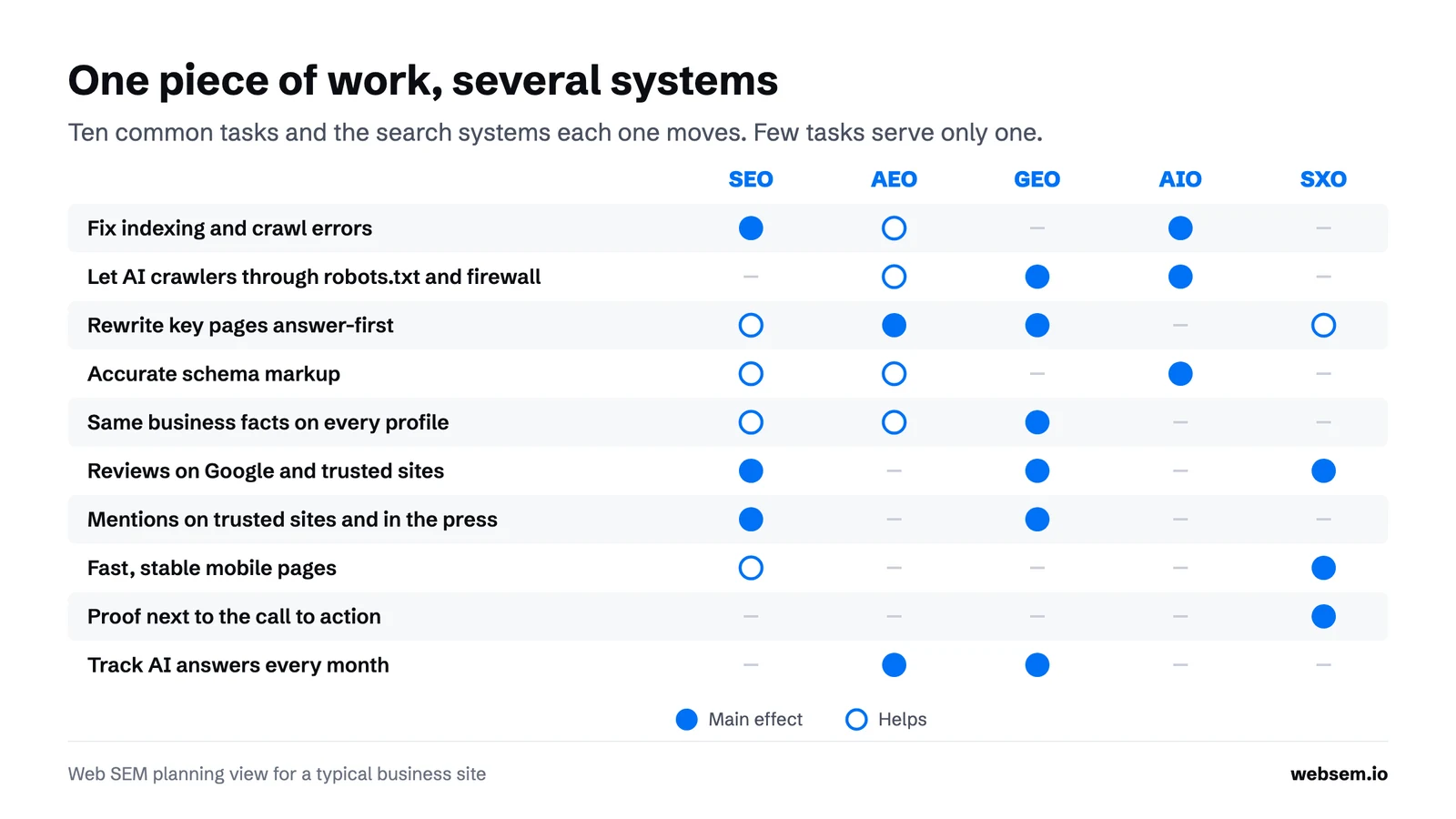
This is why we advise against splitting the five systems between separate suppliers or separate budgets. One team that owns the site, the content and the measurement can make one change that moves three systems. Five teams tend to make five reports about the same pages.
How to measure all five systems
Each system needs its own measure, but they should sit in one monthly report so you can see the trade-offs. Compare like-for-like periods, because seasonality can hide or exaggerate a change.
| System | Main measure | Where to find it | How often |
|---|---|---|---|
| SEO | Clicks, impressions and rankings for priority searches | Google Search Console, rank tracking | Weekly check, monthly report |
| AEO | Questions where your page is quoted | Manual checks or AI tracking tools, Search Console AI reports | Monthly |
| GEO | Times your brand is named and pages cited for buyer prompts | AI answer tracking across ChatGPT, Gemini, Perplexity and Copilot | Weekly or monthly |
| AIO | AI crawler visits and AI referral visits | Server logs, Bing AI Performance, GA4 AI Assistant channel | Monthly |
| SXO | Leads or sales per landing page | Google Analytics 4, CRM, call tracking | Monthly |
Which system to start with
No business should work on all five at full speed at once. Four questions decide the order:
- Can machines reach and read your site?If not, start with technical SEO and AIO. Nothing else works until this does.
- Who is your buyer?Local consumers lean on Google Business Profile, reviews and local SEO. B2B buyers with long sales cycles lean on AI assistants for research and shortlists, so AEO and GEO matter sooner.
- Where do you lose today?If you rank but do not get leads, the gap is SXO. If competitors are named in AI answers and you are not, the gap is GEO.
- How soon do you need results?Technical and conversion fixes pay back in weeks. Mentions, reviews and topical authority take months.
| Business type | Start with | Add next | Keep running |
|---|---|---|---|
| Local service business | Technical fixes, Google Business Profile, consistent business details | Answer-first service pages, review requests | Reviews, local posts, monthly AI checks |
| B2B or professional services | AI visibility audit, answer-first service pages | Expert content, mentions on industry sites | AI answer tracking, original data, LinkedIn and YouTube |
| Ecommerce store | Crawlable product pages with prices in the HTML, speed | Product schema, reviews near the buy button | Checkout friction, agent-ready product data |
| Content or media site | Indexing and topic coverage | Answer-first rewrites, freshness schedule | Citation tracking, original research |
A 90-day plan across all five systems
If you are not sure where to begin, this sequence works for most businesses:
- Days 1 to 30, the foundationfix indexing problems, check robots.txt and firewall settings for AI crawlers, view your key pages without JavaScript, correct schema and run an AI visibility audit with 30 to 50 buyer prompts.
- Days 31 to 60, the answersrewrite your two or three most valuable pages answer-first, add the missing buyer questions as headings and FAQs, make your business details match everywhere and move proof next to your calls to action.
- Days 61 to 90, the habitsstart monthly AI answer tracking, ask every happy client for a review, publish one useful piece that other sites would want to cite and set up one report that shows all five measures side by side.
After 90 days you will know which system is your biggest gap. That is where the next quarter's budget should go.
Common mistakes with SEO, AEO and GEO
- Buying the new acronym instead of fixing the basicsGoogle says AI search optimisation is still SEO. A site with indexing problems needs those fixed before any GEO tactic.
- Blocking AI crawlers by accidentFirewall defaults and security plugins are the usual cause. Check, do not assume.
- Hiding key facts in scripts, images or PDFsIf a price or service list is not in the page text, most AI tools cannot read it.
- Reporting traffic without leadsClicks are falling for many informational searches. Leads, sales and AI mentions tell you more.
- Treating AI answers as fixedThey change often. One check is a snapshot; a monthly series is evidence.
Sources
- StatCounter: search engine market share worldwide (October 2026)
- Google: Sundar Pichai at I/O 2026, AI Overviews and AI Mode users (May 2026)
- Google: AI Mode in Africa (August 2025)
- Pew Research Center: Google users are less likely to click links when an AI summary appears (July 2025)
- Ahrefs: AI Overviews reduce clicks by 58% (February 2026)
- Ahrefs: 38% of AI Overview citations pull from the top 10 (March 2026)
- Ahrefs: how SERP features have evolved in the AI era (July 2025)
- Ahrefs: brand visibility factors in ChatGPT, AI Mode and AI Overviews, 75,000 brands
- Ahrefs: AI assistants prefer to cite fresher content (July 2025)
- SparkToro: 2024 zero-click search study
- Seer Interactive: AI Overview impact on Google CTR, 2026 update
- Aggarwal et al.: GEO, Generative Engine Optimization (KDD 2024)
- Peec AI: most cited domains in AI search (March 2026)
- BrightLocal: Local Consumer Review Survey (2026)
- Google Search Central: AI features and your website
- Google Search Central: optimizing your website for generative AI features (May 2026)
- Google Search Central: FAQPage structured data
- Google Search Central: generative AI performance reports (June 2026)
- OpenAI: overview of OpenAI crawlers
- Anthropic: does Anthropic crawl data from the web
- Perplexity: Perplexity crawlers
- Vercel: the rise of the AI crawler
- Bing Webmaster Blog: AI Performance in Bing Webmaster Tools (February 2026)
- HTTP Archive: Web Almanac 2025, performance
- web.dev: Milliseconds make millions
- Nielsen Norman Group: how little do users read?
- Spiegel Research Center: how online reviews influence sales
- Baymard Institute: cart abandonment rate
- Google: Gemini 3 auto browse in Chrome (January 2026)
- Google Merchant Center: Universal Commerce Protocol
- OpenAI: buy it in ChatGPT, Agentic Commerce Protocol (September 2025)
Frequently asked questions about SEO, AEO, GEO, AIO and SXO
SEO (search engine optimisation) gets your pages ranked in Google's results. AEO (answer engine optimisation) makes your content the direct answer in AI Overviews, People Also Ask and spoken answers. GEO (generative engine optimisation) gets your brand named and cited when people ask AI assistants such as ChatGPT, Gemini or Perplexity for advice or a recommendation.
They share most of their foundations: pages that can be crawled, clear answers, accurate facts and a trusted brand. Think of AEO and GEO as extensions of SEO, not replacements for it.
SXO stands for search experience optimisation. It covers what happens after someone clicks: whether the page matches what they searched for, loads fast on a phone, is easy to scan and puts proof such as reviews next to the call to action.
SXO is measured in leads or sales per page, not traffic. It is often the quickest way to get more value from the visitors you already have.
AIO is used in two ways. Many people use it as shorthand for Google's AI Overviews. In the five-system framework it means AI optimisation: making sure AI tools can fetch, read and understand your pages.
That covers crawler access in robots.txt and firewalls, text that is readable without JavaScript, accurate structured data and tracking AI visits and impressions.
No. Most tasks move several systems at once. Fixing indexing helps SEO, AEO and AIO; an answer-first rewrite helps AEO and GEO and often conversion too.
Plan the five systems as one programme with one owner and one monthly report that shows all five measures. Separate projects tend to repeat work on the same pages.
Yes. Google still handled about 91% of worldwide searches in October 2026. Its AI features draw on the same index and quality signals as normal results. Google says there are no extra requirements to appear in AI Overviews or AI Mode beyond being indexed and eligible.
What has changed is how you measure success. Clicks matter less on their own; leads, sales and how often your brand is named in AI answers matter more.
Write 30 to 50 questions your buyers would ask, run them across ChatGPT, Gemini, Perplexity, Copilot and Google's AI Mode on a fixed schedule and record which brands are named and which pages are cited.
Add the AI Assistant channel in Google Analytics 4, the generative AI reports in Google Search Console and the AI Performance report in Bing Webmaster Tools to see impressions and visits alongside the mentions.
Start with the foundation: make sure Google and AI crawlers can reach and read your site, then get your Google Business Profile, reviews and business details right everywhere. For a local business those steps feed SEO, AEO and GEO at the same time.
Next, rewrite your most important service pages answer-first and put reviews next to your contact form. Add monthly AI answer tracking once the basics are in place.


