
No, SEO is not dead. People have announced its death at least once a decade since 1997. Google Search has grown through every one of them: from about 1.2 trillion searches in 2012 to more than 5 trillion a year by 2025. What dies each time is an old way of doing SEO, not the need to be found.
"SEO is dead" has become a broken record. This post plays the whole record, one track at a time: what was said, what actually changed and what happened next. Then it looks at what is genuinely different about AI search and what still works in 2027.
Why people keep saying SEO is dead
Every few years something new arrives in search: a paid ad slot, a social network, an algorithm update, an AI tool. Each one makes some old tactic stop working. The people who relied on that tactic feel the loss first and loudest, so "SEO is dead" spreads faster than the quieter fact that search kept growing underneath it.
There is also a commercial reason. A new channel needs a story. "The old thing is finished" is an easy one to sell. Paid search used it in 2000, social media in 2006 and AI assistants in 2023. Each of those channels turned out to be real and worth using. None of them made organic search go away.
The pattern is easier to see on one timeline. Google only publishes a total number of searches now and then, but every total it has published sits on a rising line, with an "SEO is dead" moment on either side of it.

Every time SEO died and what happened next
1997: "Search engines are a dead-end technology"
The first eulogy is usually traced to a November 1997 post by Richard Hoy, who wrote that he was beginning to believe search engines were "a dead-end technology". His advice was to write good meta tags, submit the site and forget about it. The same year, the phrase "search engine optimisation" came into use and google.com was registered on 15 September 1997.
What happened next: search became the main way people find anything online. The lesson from the first track on the record is the one that keeps repeating: the tactic of the day (meta tags) stopped mattering, but being findable did not.
2000: "Paid ads will kill organic"
Google launched AdWords in October 2000. If businesses could pay for the top of the page, the thinking went, nobody would bother earning a place below it.
What happened next: paid and organic grew up side by side. Ads suit searches where you want a sale this week. Organic results earn trust and keep working after the budget stops. Most businesses that do well in search today use both, with each channel showing which searches are worth more investment in the other.
2006: "Social will replace search"
Facebook opened to anyone over 13 in September 2006 and Twitter launched the same year. The claim was that people would find things through friends and feeds, not search boxes.
What happened next: social became huge for discovery, but it answers a different need. A feed shows you things you were not looking for. A search box is where you go when you already know what you need. Google said it handled about 1.2 trillion searches in 2012, six years into the social era.
2012: "Backlinks are dead"
Google's Penguin update arrived in April 2012 and Google said it affected about 3.1% of English searches. It targeted link schemes: bought links, link networks and keyword-stuffed anchor text. Sites that had climbed on cheap links fell overnight. Many of their owners declared links and SEO finished.
What happened next: links still matter, but only the kind that a real person would choose to give. Penguin killed link buying as a shortcut. It made earned mentions from relevant, trusted sites more valuable, which is exactly the kind of reputation AI tools now read too.
2015: "Machine learning killed SEO"
In October 2015 Google confirmed RankBrain, a machine learning system that helps it understand searches it has never seen before. Google called it one of its most important ranking signals. If a machine decides what ranks, the argument went, there is nothing left to optimise.
What happened next: machine learning made exact-match tricks pointless and rewarded pages that answer the meaning behind a search. Writing for the person instead of the keyword stopped being advice and became the method. A year later Google said it handled at least 2 trillion searches a year.
2022: "TikTok is the new search engine"
In July 2022 a Google senior vice president said that almost 40% of young people looking for a place to have lunch went to TikTok or Instagram, not Google Maps or Search. That one line produced a year of "Google is finished" headlines.
What happened next: video and social search are real. For some purchases they now come first. But people check what they see there against Google before they spend. Google also started showing short videos and forum posts in its own results. Visibility on YouTube, TikTok and Reddit became part of search work, not a replacement for it.
2023: "ChatGPT has made Google useless"
ChatGPT launched on 30 November 2022 and reached an estimated 100 million monthly users by January 2023, at the time the fastest growth of any consumer app. If an assistant could write the answer, why would anyone scroll through ten blue links?
What happened next: AI assistants became a second front door, but Google kept the first one. It reported more than 5 trillion searches a year in March 2025, the highest total it has ever published. And when an assistant needs current facts, it searches the web, which means it reads pages that SEO helped it find.
2024: "AI Overviews will end SEO"
Google put AI Overviews at the top of US results in May 2024 and has rolled them out widely since. For the first time, Google itself was writing the answer above the organic results.
What happened next: searches went up, not down. Google says AI Overviews drive over 10% more searches for the types of questions that show them. By May 2026 they had more than 2.5 billion monthly users. AI Overviews also quote and link to web pages. They lean heavily on pages that already rank well.
2026: "This is the end of SEO"
At Google I/O in May 2026, Google said AI Mode, its chat-style search, had passed 1 billion monthly users within a year. AI Mode has been available in South Africa since August 2025. ChatGPT, Gemini, Perplexity and Claude are now daily tools for millions of people, which is where the latest round of "SEO is dead" comes from.
What happened next: this track is still playing. In November 2026 Google even removed the Search button from its desktop homepage in favour of AI shortcuts. What is clear so far is that AI Mode, like AI Overviews, runs on Google's search index. A page that Google cannot crawl, understand or trust is very unlikely to be quoted in either.
The pattern: what dies is a tactic, not SEO
Look at the record as a whole and the same thing happens every time. A shortcut stops working, the people who relied on it call SEO dead and the businesses that did the real work carry on.
| Claim | What actually died | What survived |
|---|---|---|
| 1997: search is a dead end | Meta tags as a ranking trick | Being findable when people search |
| 2000: paid ads will kill organic | The idea of one channel for everything | Organic results as the trusted, long-term source |
| 2006: social will replace search | Search as the only route to discovery | Search for people who already know what they need |
| 2012: backlinks are dead | Bought and spammy links | Earned links and mentions from relevant sites |
| 2015: machine learning killed SEO | Exact-match keyword tricks | Pages that answer the real question |
| 2022: TikTok is the new search engine | Google as the only place people search | Search across Google, video and social |
| 2023: ChatGPT made Google useless | The idea that search is one website | Clear, citable facts that any engine can use |
| 2024 to 2026: AI Overviews and AI Mode | Ranking as the only measure of success | Being ranked, quoted and chosen |
What is different about AI search
It would be lazy to say nothing has changed this time. Something has: the click. When Google answers the question on the results page, fewer people need to visit a website to get it.
Pew Research Center tracked the browsing of 900 US adults in March 2025. People clicked a normal search result on 8% of Google visits that showed an AI summary, against 15% of visits that did not. They clicked a link inside the AI summary itself on only 1% of visits.
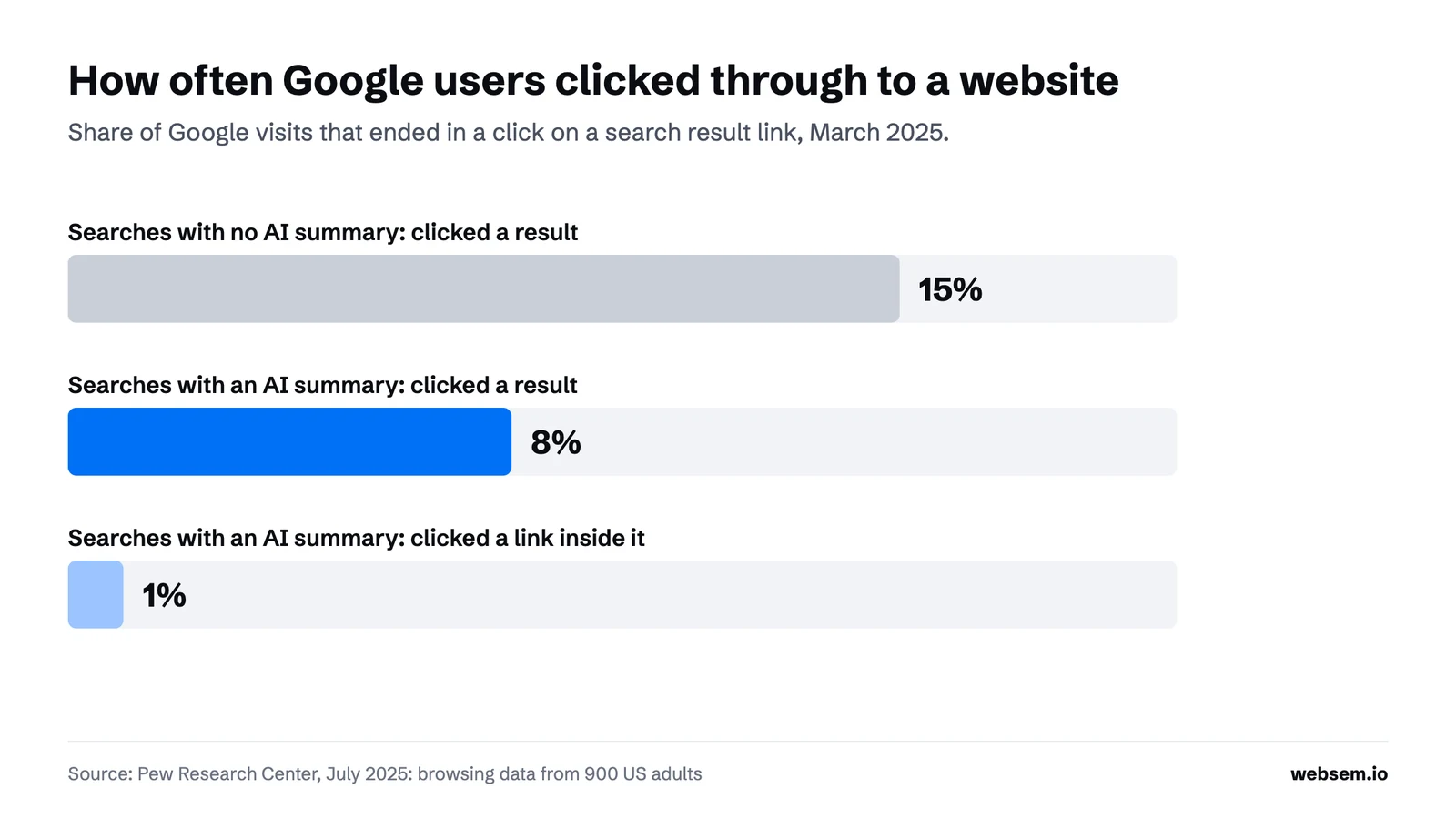
So the job has changed shape. Searches are growing, but each search sends fewer visitors to websites, especially for simple "what is" questions. The searches that still send clicks tend to be the ones closer to a decision: comparing providers, checking prices, looking for a local service or asking how to do something properly.
That means SEO is now measured on three things, not one:
- FoundYour pages rank in Google for the searches your buyers make.
- QuotedAI Overviews, AI Mode and assistants such as ChatGPT use your pages and name your business in their answers.
- ChosenWhen someone does click, the page gives them a clear reason to call, buy or book.
All three still start with the same foundations. AI search is not replacing SEO. It is building on top of it.
Is SEO still worth it in 2027?
For most businesses, yes, but the reason has changed. SEO used to be sold as "more traffic". In 2027 it is better thought of as making sure that wherever a buyer asks, on Google, in AI Mode or in ChatGPT, your business is part of the answer.
It is worth the most when:
- People search for what you sell before they buy it, which is true for nearly every service business.
- Your buyers compare options over days or weeks, so they meet you several times before deciding.
- You sell in a market where competitors are already named in AI answers and you are not.
- You want a source of leads that keeps working when an ad budget is paused.
It is worth the least when nobody searches for what you sell yet, for example a brand-new product category. Then awareness channels such as social and video ads come first and search follows once people know what to look for.
What still matters for SEO
Strip away every "SEO is dead" headline and four jobs have survived every update since 1997. They matter even more for AI search, because AI tools need the same things Google does, only with less patience.
1. A site that is easy to crawl and index
Search engines and AI crawlers have to fetch your pages, read the text and add them to an index before anything else can happen. Check the Pages report in Google Search Console for important pages that are not indexed. Make sure your key facts are in the page text, not only in images, PDFs or scripts, because most AI crawlers do not run JavaScript. Check that your firewall or security plugin is not blocking the AI crawlers you want to be found by.
2. Content that answers real questions
Write for the questions buyers actually ask, from "what is" to "how much" to "which provider". Put the answer in the first sentence or two under each heading, then give the detail. AI tools quote passages, not whole pages, so a clear answer near the top of a section is more likely to be used than one buried in paragraph four.
3. Quality backlinks and brand authority
Links from relevant, trusted sites still tell Google that a page deserves to rank. Mentions of your business on other sites, in reviews, on YouTube and in forums now matter almost as much, because AI tools build their picture of a brand from what others say about it. The goal is to be the business that people in your industry would naturally mention.
4. Content that is fresh and accurate
Pages lose ground as competitors update theirs and as facts go out of date. Review your most important pages at least twice a year: update figures, remove anything that is no longer true and add the questions buyers have started asking. Keep your business details the same everywhere, from your website to your Google Business Profile to directory listings, so no search engine or AI tool has to guess which version is right.
The next time someone says SEO is dead
Ask them what exactly has died. Usually the honest answer is a tactic: a type of link, a keyword trick or the idea that ranking on its own is enough. That is useful to know, because it tells you what to stop doing.
Then look at what has not changed. People still search before they buy, more often than ever and in more places than ever. The businesses that keep doing the basics well and add AI search on top are the ones that will still be found when the record plays again.
Sources
- Google: Zeitgeist 2012 (1.2 trillion searches in 2012)
- Search Engine Land: Google now handles at least 2 trillion searches per year (May 2016)
- Search Engine Land: Google now sees more than 5 trillion searches per year (March 2025)
- StatCounter: search engine market share worldwide (October 2026)
- Search Engine Land: Is SEO dead? A 1997 prediction meets 2009 reality
- Fortune: Google exec says young people use TikTok and Instagram to search (July 2022)
- TechCrunch: AI Overviews have 2 billion monthly users (July 2025)
- Google: Sundar Pichai at I/O 2026 (May 2026)
- Google: AI Mode in Africa (August 2025)
- Pew Research Center: Google users are less likely to click links when an AI summary appears (July 2025)
- Ahrefs: 38% of AI Overview citations pull from the top 10 (March 2026)
Frequently asked questions about whether SEO is dead
No. Google reported more than 5 trillion searches a year in 2025, more than double its 2016 figure. It still held about 91% of worldwide search in October 2026. People are searching more than ever. What has changed is how many of those searches end in a click to a website, because AI Overviews and AI Mode now answer many simple questions on the results page.
SEO in 2026 is still about being found, but the goal is wider than ranking. You want your pages to rank, to be quoted in AI answers and to convert the visitors who do click. Those three goals rest on the same foundations: a crawlable site, clear answers, a trusted brand and accurate content.
AI is changing SEO rather than replacing it. AI Overviews and AI Mode run on Google's search index. Assistants such as ChatGPT search the web when they need current facts. A page that search engines cannot find, read or trust is unlikely to be cited by an AI tool either.
What AI does replace is some of the click. Simple factual questions are increasingly answered without a visit. That is why newer terms such as answer engine optimisation (AEO) and generative engine optimisation (GEO) have appeared. They describe extra work on top of SEO, such as answer-first writing and earning brand mentions, not a separate discipline that makes SEO unnecessary.
Usually, yes, especially for service businesses whose customers search before they buy. Local searches such as a service plus a town or suburb still send calls, directions and website visits. The Google Business Profile that appears for them is part of SEO. Unlike ads, the results keep working after you stop paying for them.
The key is to focus. A small business does not need to rank for everything. Pick the services that matter most, make sure each has one strong page that answers buyers' questions, keep your Google Business Profile complete and ask happy customers for reviews. That covers most of what both Google and AI tools look for.
Yes, but the reward looks different. Pew Research Center found that people clicked a result on 8% of Google searches with an AI summary, against 15% without one. Fewer clicks per search is a real loss for pages that only answer simple questions. At the same time, Google says AI Overviews lead to over 10% more searches for the questions that show them.
AI Overviews also cite web pages. They favour pages that already rank well: Ahrefs found about 38% of cited pages also rank in the top 10 for the same search. Being the page that is quoted keeps your brand in front of buyers even when they do not click. The searches closer to a purchase still send visitors.
The future of SEO is search everywhere: Google results, AI Overviews, AI Mode, ChatGPT, Perplexity, YouTube and social platforms. Each one rewards the same core qualities, which are content that answers real questions, facts that are easy to verify and a brand that other trusted sources talk about.
Expect measurement to change more than the work itself. Rankings and clicks will sit next to new measures such as how often AI tools name your business, which of your pages they cite and how many leads come from AI assistant visits. Businesses that track all three, found, quoted and chosen, will see where to invest next.


