The best SEO and AEO tactics for 2027 are the ones that match your effort budget and how soon you need results. Sort every tactic by two questions: how much work it takes and how long it takes to move traffic, leads or AI mentions. Start with the low-effort fixes that pay back in weeks, fund one or two bigger projects that pay back within a quarter and keep the slow, compounding work running in the background every month.
This guide sorts 20 SEO and answer engine optimisation (AEO) tactics into four groups on that basis. It explains what each tactic involves, why it matters now that Google's AI Overviews, AI Mode, ChatGPT and Gemini answer so many questions directly and how to choose the right mix for your business.
Why a priority matrix beats a list of trends
Most "SEO trends" articles give you a list. A list does not tell you what to do on Monday. A marketing manager with one content writer and a developer for two days a month needs a different plan from a company that can fund a research report and a PR campaign.
A priority matrix fixes that. It places each tactic on two lines: effort (people, money and developer time) and time to impact (how long before you can see the change in Search Console, Google Analytics or AI answer tracking). The result is four groups:
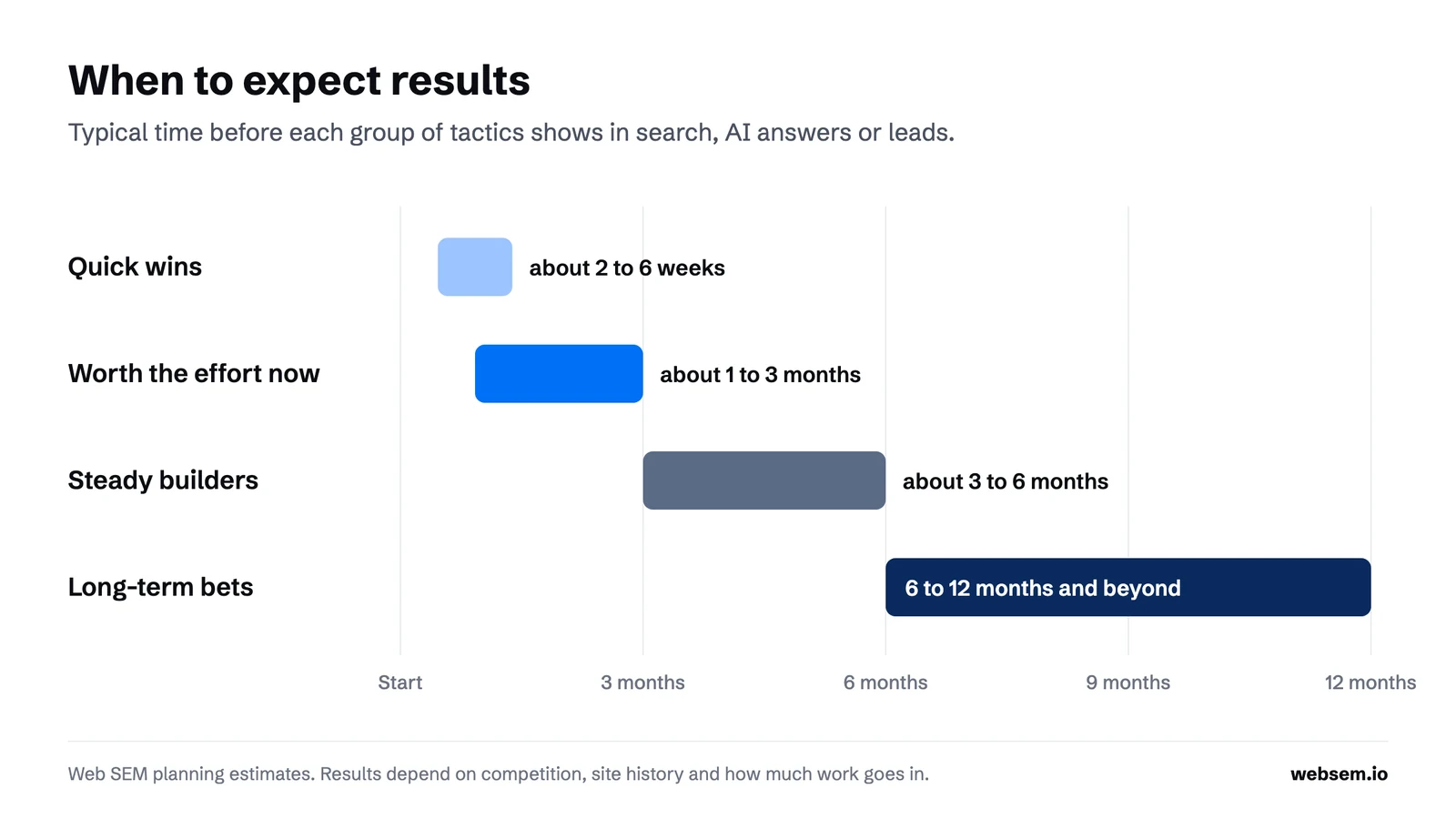
- Quick winsLow effort, results in weeks.
- Worth the effort nowMore work, results within one to three months.
- Steady buildersSmall monthly habits that pay off over three to six months.
- Long-term betsBigger investments that build authority over six to twelve months and beyond.
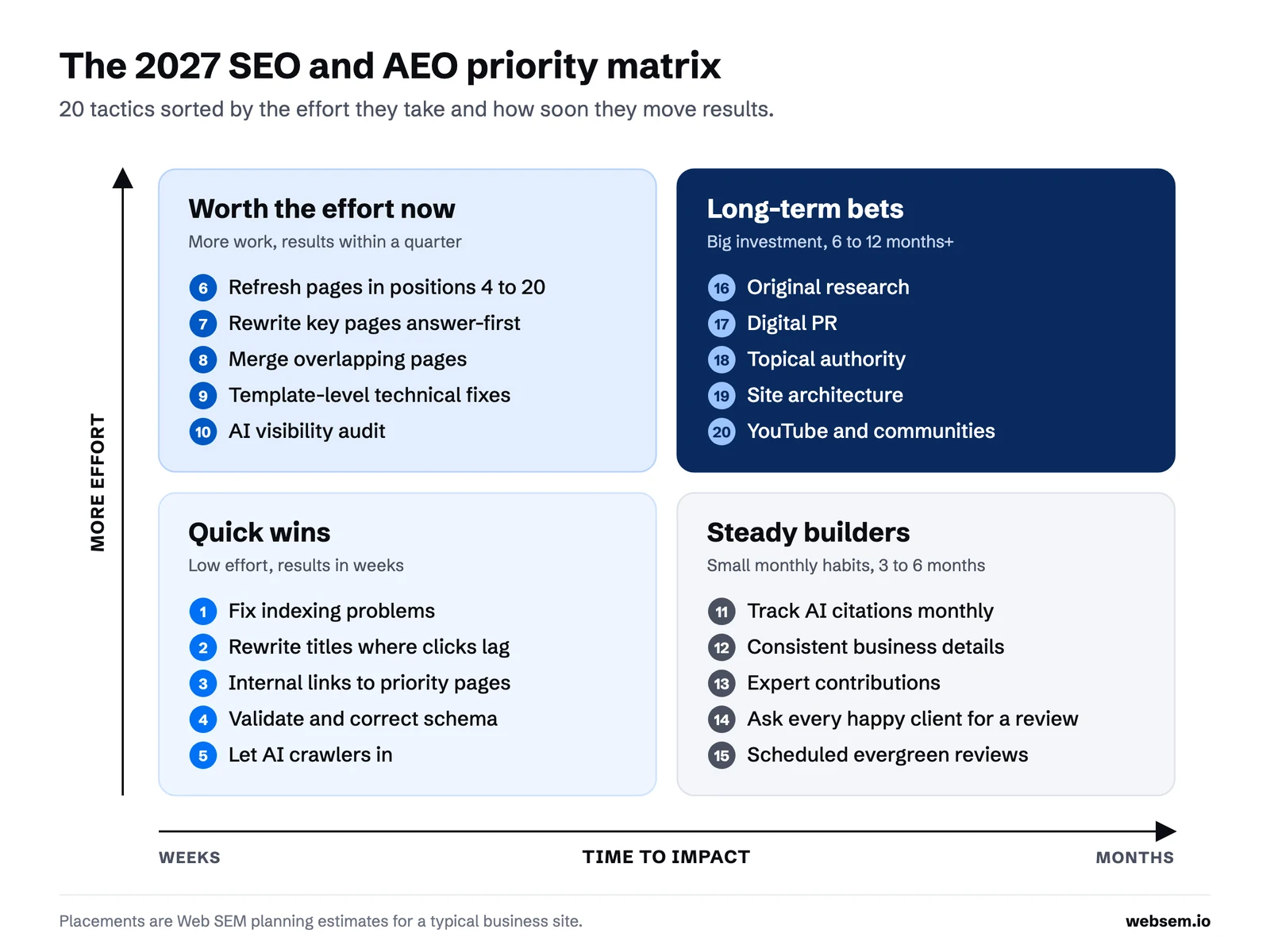
A tactics matrix along these lines has been shared widely online. It is a useful idea, but some of its placements do not hold up in practice. It files original research as a low-investment tactic, when a credible study takes weeks of work and real budget. It files Core Web Vitals under long-term investments, when a single image or script fix on a page template can move the numbers within one 28-day reporting window. It also lists content refresh and content updates as separate tactics. The version in this guide corrects those placements and adds the AI-specific work, such as crawler access and citation tracking, that a 2027 plan needs.
Quick wins: low effort, results in weeks
These five tactics need little more than access to Google Search Console, your content management system and a few hours. Do them first. They remove the problems that stop good pages from being found by search engines and AI tools at all.
1. Fix indexing problems
A page that is not indexed cannot rank and cannot be cited. Google's own AI features guidance makes this the first requirement. Open the Pages report in Search Console and look for important pages under "Crawled, currently not indexed", "Excluded by noindex tag" or "Alternate page with proper canonical tag". Check that your sitemap lists only live, indexable addresses with no redirects. Then use URL Inspection to request indexing for the pages that matter most.
2. Rewrite titles and meta descriptions where clicks lag
Filter Search Console for pages with high impressions and a click-through rate well below the site average for their position. These pages are already being shown. A clearer title that matches what people search for, plus a meta description that answers the question and gives a reason to click, can lift clicks without any change in ranking. With AI Overviews taking a share of clicks, the clicks that are left are worth winning.
3. Add internal links to your priority pages
Internal links tell search engines which pages matter and help crawlers find new ones. Pick the five to ten pages that bring in revenue. Find older pages on related topics that already earn traffic and add a link from each, with anchor text that describes the target page. It takes an afternoon and costs nothing.
4. Validate and correct schema markup
Run your key templates through Google's Rich Results Test and the Schema Markup Validator. Fix errors in Organization, LocalBusiness, Product, Article and Review markup and make sure the markup matches what is visible on the page. Google stopped showing FAQ rich results on 7 May 2026 and has retired several other rich result types since 2025, so check that you are not spending time on markup that no longer earns a search feature. Accurate schema still helps machines understand who you are and what each page is about.
5. Let AI crawlers in
Many sites block AI tools without knowing it. Check robots.txt for rules that block crawlers such as OAI-SearchBot and GPTBot (OpenAI), PerplexityBot or ClaudeBot. Then check your firewall or bot protection: some security settings block every automated visitor, including the crawlers that feed AI answers. If a tool cannot read your pages, it will describe your business from what other sites say instead.
Worth the effort now: more work, results within a quarter
These five tactics need a writer, a developer or a specialist for a few days to a few weeks. They are where most of the measurable growth in a typical year comes from.
6. Refresh pages in striking distance
Pages that rank in positions 4 to 20 are the fastest route to more traffic. Google already sees them as relevant. They need better answers, newer facts, clearer structure or stronger proof. Update the statistics, answer the questions people ask in the first paragraph of each section, add a comparison table or worked example and change the published date only when the content has really changed. Fresh content also suits AI assistants, which tend to cite newer pages.
7. Rewrite key pages answer-first
AI answers quote passages, not whole pages. Your service, product and category pages should state the answer in the first sentence under each heading, then give detail: prices or price ranges, timelines, who it suits, what is included and what it is not. Pages written this way are easier to quote, easier to scan and convert better. Start with the pages that earn revenue.
8. Merge overlapping pages
Two or three pages chasing the same search split your signals and confuse both Google and AI tools about which page to show. Find overlaps in Search Console (several of your pages getting impressions for one query), combine the best content into one page and redirect the others to it with a 301 redirect. Update internal links so they point straight to the surviving page.
9. Fix technical issues at template level
Fix problems once in the template, not page by page. That includes Core Web Vitals: Google rates a page good when its Largest Contentful Paint is under 2.5 seconds, its Interaction to Next Paint is under 200 milliseconds and its Cumulative Layout Shift is under 0.1, measured on real visits. One oversized hero image, a slow chat widget or a late-loading font on a template can fail every page built on it. Also check that important content is in the HTML itself and does not depend on scripts that crawlers may not run.
10. Run an AI visibility audit
Before you spend money on AEO, measure where you stand. Write 30 to 50 prompts your buyers would ask an AI assistant ("best accounting software for small businesses in South Africa", "how much does solar installation cost in Cape Town") and check which brands ChatGPT, Gemini, Perplexity, Copilot and Google's AI Mode name, which pages they cite and what they say about you. This baseline shows which competitors win the answers and why. It also gives you something to measure every later tactic against.
Steady builders: small habits that compound
These five tactics take an hour or two a week. None of them changes much in a month. Kept up for six months, they build the trust signals that both search engines and AI tools look for.
11. Track AI citations every month
Run the same prompts from your audit every month and record which engines mention you, which pages they cite and which competitor sources they cite instead. The cited sources are your to-do list: if AI answers keep citing a directory, a comparison article or a review site, that is where your brand needs to appear. Track AI referral visits in Google Analytics alongside it, so you can see whether more mentions bring more visits and leads.
12. Make your business details consistent everywhere
AI tools build their picture of your business from many sources. Your name, address, phone number, services and description should match across your website, Google Business Profile, Bing Places, industry directories, LinkedIn and review sites. Link your website's Organization schema to these profiles with the sameAs property. Keep your About page specific: who you are, when you started, who you serve and who leads the work.
13. Put your experts in front of people
Answer journalist requests, offer comments on news in your industry, speak on podcasts and give each author on your site a proper bio with real experience. Expert contributions build the mentions on other sites that correlate with AI visibility. They also show Google the experience behind your content, which matters most for topics where advice affects money, health or safety.
14. Ask every happy client for a review
Reviews on Google, industry sites and platforms such as Hellopeter feed local rankings and give AI tools language to describe you. Ask at the moment the work goes well, make it easy with a direct link and reply to every review, good or bad. A steady stream of recent reviews counts for more than a burst of old ones.
15. Review your evergreen content on a schedule
Make a list of the 20 pages that bring in the most traffic or leads and review each one at least twice a year. Check that facts, prices, screenshots and recommendations are still correct and add what has changed. This is the habit that stops slow traffic decline before it shows up in a monthly report.
Long-term bets: authority that competitors cannot copy quickly
These tactics need budget, senior time and patience. They are also the ones that build a lead competitors cannot close with a few blog posts.
16. Publish original research
Survey your customers, analyse your own anonymised data or run a benchmark that nobody else has. Original figures give journalists, bloggers and AI tools a reason to cite you as the source. Keep the method clear, publish the sample size and date and give each key finding its own short, quotable sentence. One strong study a year can earn mentions for several years.
17. Run digital PR
Digital PR earns coverage and mentions on news and industry sites. Pair it with your research, with expert comment on topical stories or with data-led stories about your region or industry. The goal has shifted: a mention of your brand on a trusted site is now worth almost as much as the link, because AI tools learn about brands from what credible sites say about them.
18. Build topical authority
Cover your core subjects in depth, not in scattered posts. Map the questions buyers ask at each stage, from "what is" to "how much" to "which provider". Then build a hub page with supporting articles that link to each other. Google builds AI answers by running many related searches at once, so a site that answers the whole set of questions has more chances to be cited than one that answers a single query well.
19. Restructure your site architecture
When a site has grown for years without a plan, important pages end up four or five clicks from the home page and categories overlap. A restructure groups pages by topic and service, shortens click paths to revenue pages and gives every page one clear place. It needs careful redirect mapping and a migration plan, which is why it sits in the long-term group, but it lifts every other tactic once it is done.
20. Show up on YouTube and in communities
In Ahrefs' study of 75,000 brands, YouTube mentions had the strongest link to AI visibility of any factor tested. Short, practical videos that answer buyer questions, posted on your own channel, give AI tools another source to draw on. Helpful, honest answers in relevant communities and forums do the same. Treat both as long-term publishing channels, not one-off campaigns.
How to choose your SEO and AEO mix
No business should run all 20 tactics at once. Four questions decide the mix:
- Who is your buyer?A business that sells to consumers in one city leans on reviews, Google Business Profile and local pages. A B2B company with a long sales cycle leans on expert content, research and AI visibility, because buyers ask AI tools to compare providers.
- How soon do you need results?If this quarter's leads matter most, weight the plan towards quick wins and the worth-the-effort group. If you are building for next year, protect budget for the long-term bets.
- What resources do you have?Writers, developers, subject experts and budget each unlock different tactics. A site with no developer time should not start with a restructure.
- Where are you losing today?Your AI visibility audit and Search Console data show whether the gap is technical, content or authority. Fix the biggest gap first.
| Business type | Start with | Add next | Keep running |
|---|---|---|---|
| Local service business | Indexing fixes, titles, consistent business details | Answer-first service pages, review requests | Reviews, Google Business Profile posts, citation tracking |
| B2B or professional services | AI visibility audit, AI crawler access, schema | Striking-distance refreshes, page merges | Expert contributions, original research, digital PR |
| Online store | Template-level technical fixes, product schema | Answer-first category pages, internal links | Product reviews, evergreen buying guides, YouTube |
A 90-day starting plan
If you are not sure where to begin, this sequence works for most businesses:
- Days 1 to 30fix indexing, let AI crawlers in, correct schema, rewrite the ten weakest titles and run the AI visibility audit.
- Days 31 to 60refresh the five pages closest to page one, rewrite your two most valuable service or category pages answer-first and merge any overlapping pages.
- Days 61 to 90start the monthly habits (citation tracking, reviews, expert contributions) and choose one long-term bet for the next two quarters.
Measure each step against the baseline: Search Console clicks and impressions for the pages you changed, AI referral visits and leads in Google Analytics and your monthly share of mentions across AI engines. Compare like-for-like periods, so seasonality does not distort the picture.
Sources
- Ahrefs: AI Overviews reduce clicks by 58% (February 2026)
- Ahrefs: 38% of AI Overview citations pull from the top 10 (March 2026)
- Ahrefs: top brand visibility factors in ChatGPT, AI Mode and AI Overviews, 75,000 brands
- Ahrefs: AI assistants prefer to cite fresher content, 17 million citations
- Seer Interactive: AI Overview impact on Google CTR, 2026 update
- Google Search Central: AI features and your website
- Google Search Central: simplifying the search results page
Frequently asked questions about SEO and AEO in 2027
SEO (search engine optimisation) helps your pages rank in search results. AEO (answer engine optimisation) helps your brand get named and cited in answers from AI tools such as Google's AI Overviews and AI Mode, ChatGPT, Gemini and Perplexity. Our guide to SEO vs AEO vs GEO shows how they fit together with AIO and SXO.
AEO builds on SEO rather than replacing it. Both need pages that can be crawled, understood and trusted.
Fixing indexing problems, rewriting titles and meta descriptions on pages with low click-through rates, adding internal links to priority pages and correcting schema markup usually show results within weeks.
Refreshing pages that rank in positions 4 to 20 is the fastest of the larger tactics.
Google says there are no extra requirements to appear in AI Overviews or AI Mode. A page must be indexed and eligible to show in Search, so normal SEO fundamentals still apply.
Clear answers, accurate facts and mentions on trusted sites make a page more likely to be cited.
Technical fixes such as letting AI crawlers in can change what AI tools say within weeks. Content rewrites usually take one to three months. Authority work such as digital PR and original research takes six months or more to show in AI answers.
Yes, for accurate core types such as Organization, LocalBusiness, Product, Article and Review. Google stopped showing FAQ rich results in May 2026, so FAQ markup no longer earns a search feature, but correct schema still helps machines understand your business and pages.
Track a fixed set of buyer prompts across named AI engines every month and record which brands are mentioned and which pages are cited. Combine that with AI referral visits in Google Analytics and compare like-for-like periods.