
Click-through rate (CTR) is the percentage of searchers who click on an organic Google result. It has long been one of the most important metrics in SEO and digital marketing. For years, marketers focused on optimising content to reach top rankings and capture as many clicks as possible from Google’s traditional list of “blue links.” The search environment is now changing quickly. Artificial intelligence (AI) powered searches, including Google’s new generative AI results and standalone AI chatbots, are reshaping how people interact with search.
As AI delivers more answers directly on the results page, fewer users are clicking through to websites. This shift is disrupting long-established CTR patterns. In this report, we review current industry research and expert perspectives on how AI-driven search is influencing organic CTR, and what marketing leaders should consider as they adapt to this new landscape.
The Rise of AI-Powered Search
AI has quickly become embedded in search behaviour. OpenAI’s ChatGPT burst onto the scene in late 2022, showing millions of users a new way to get answers through a conversational AI assistant. By early 2025, ChatGPT had over 100 million users and about 15% of U.S. web users reported using it regularly (Arc Intermedia). More than one-third of generative AI users say they have begun replacing some traditional Google searches with AI assistants.
Certain niches illustrate this vividly. Roughly 30% of computer programming-related queries were handled on ChatGPT in Q1 2025 (Arc Intermedia), as developers increasingly asked coding questions of AI instead of Google or Stack Overflow. Microsoft’s Bing integrated GPT-4 into its search engine, and new AI search engines such as Perplexity AI emerged, combining large language model answers with source citations.
Most significantly, Google introduced the Search Generative Experience (SGE) ,an AI summary at the top of search results. Launched as an opt-in experiment in mid-2023, SGE was rolled out widely in the U.S. by late 2024. By 2025, AI-generated answers had become commonplace: one analysis found an AI overview appeared in 86.8% of searches for 1,000 commercial terms tested (Arc Intermedia). Overall, roughly 84% of all Google queries were influenced by generative AI results. In categories like shopping and apparel, the AI summary appeared in nearly 99% of searches.
In short, AI-driven results are now routine, meaning users are frequently getting answers without needing to click through to websites.
AI Search and the “Zero-Click” Phenomenon
Even before AI, Google had been moving towards answering queries directly (via featured snippets, knowledge panels, etc.), contributing to a rise in “zero-click searches.” A zero-click search is one where the user does not click any external website result. AI has greatly accelerated this trend. In 2024, nearly 64% of Google searches in the U.S. ended without any click to an external site (Arc Intermedia). A SparkToro study showed that only around 36% of U.S. searches led to a click to the “open web,” while the rest stayed within Google’s ecosystem. As Google CEO Sundar Pichai noted, when AI provides an answer with cited sources, users often feel less need to click additional links.
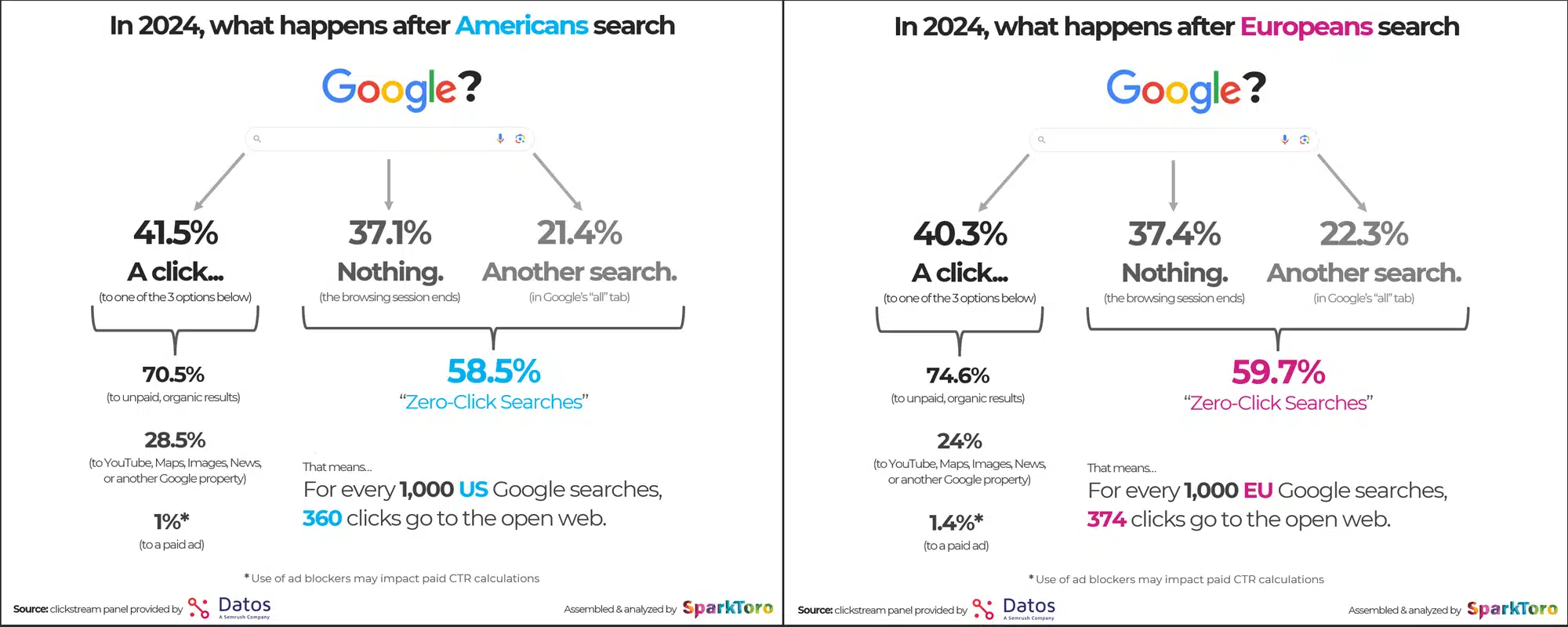
Figure: A 2024 study by SparkToro and Datos shows what happens after a Google search in the U.S. vs. EU. In the United States, a majority of searches (≈60%) ended with no click to any external website, reflecting the growing zero-click trend. Only about 36% of U.S. searches resulted in a click to the “open web” (organic results on non-Google sites), while the remainder either led to another Google property or to a new search
Several factors drive this zero-click behaviour. AI-powered results directly answer users’ questions – often pulling together information from multiple sources – so the user may not need to visit a website for more detail (Good & Gold). Additionally, interactive AI results can engage users further on the results page itself. For example, Google’s SGE often suggests follow-up questions related to the query; users can click those and continue exploring within Google’s interface, rather than clicking out to a third-party site.
Voice search is another contributor to zero-click searches. When an AI voice assistant such as Siri, Alexa or Google Assistant reads an answer aloud, the user isn’t clicking anything. All these AI-driven conveniences mean fewer opportunities for organic listings to earn clicks.
Early Evidence of CTR Decline in the Age of AI
Multiple studies in 2024–2025 quantified a sharp decline in organic CTR wherever AI results appeared:
-
An Ahrefs analysis of 300,000 searches found that the presence of an AI overview caused CTR for the top organic result to fall by 34.5%.
-
A study by Amsive covering 700,000 keywords saw an average CTR drop of 15.5% across all organic results, with larger losses where featured snippets and AI co-existed.
Real-world traffic data supports these findings. A joint experiment by Search Engine Land and Agile SEO observed that organic traffic on certain high-volume keywords fell between 18% and 64% when Google’s AI snapshots were displayed prominently. In July 2025, GrowthSRC Media released a report analysing over 200,000 keywords from 30 websites (spanning e-commerce, SaaS, B2B, and education sectors) and found that Google’s top organic listings were receiving far fewer clicks. The #1 organic result’s average CTR dropped from about 28% to 19% (a 32% decline) after AI overviews rolled out widely. The #2 result fared even worse, dropping from ~20.8% to 12.6% CTR (a 39% decline) year-over-year.
A striking example comes from the news publishing industry: MailOnline (Daily Mail) reported that when their articles ranked #1 in Google, they would normally see around a 13% CTR on desktop (20% on mobile). But if an AI summary appeared on those searches, their CTR dropped to below 5% on desktop (and ~7% on mobile). That is more than a 50% reduction in click rate for top-ranking news content whenever an AI answer was present.
It’s not just Google’s own AI that is siphoning clicks. Independent AI search tools and chatbots have an even more dramatic impact on outbound clicks. For example, OpenAI’s ChatGPT often gives complete answers without any direct links, resulting in negligible CTR. Industry data shows that AI chatbots like ChatGPT and Perplexity drive 95–96% less referral traffic to websites compared to traditional search (Arc Intermedia). In fact, click-through rates from pure AI answers (e.g. ChatGPT’s responses) are typically below 1%, essentially an order of magnitude lower than CTR from a regular Google search results page.
In other words, when users turn to these AI assistants, almost no one clicks out to source websites for further reading. The AI provides the information needed in-line, and the user’s session often ends without visiting external sites.
How AI is Changing User Behaviour
AI is changing search behaviour in several ways:
-
Reading answers instead of scanning links: Users often stop at the AI summary.
-
“Position 0” dominance: The AI box attracts clicks, sometimes elevating sources that were not ranking on page one (Arc Intermedia).
-
Multi-turn refinements: Users engage in follow-up queries directly within the AI interface.
-
Selective clicking of citations: If a site is cited in the AI box, it may capture concentrated clicks, even if not top-ranked (Search Engine Journal).
-
SERP displacement: Expanded AI boxes push organic results far below the fold – sometimes more than 1,200 pixels down (Authoritas).
This visual displacement means many users will not even see the first organic link without extra scrolling. Google has also introduced more interactive elements (such as AI follow-up questions, conversational refinements, and shopping widgets) that keep users engaged within Google’s results for longer (Search Engine Journal). All of this reduces the likelihood and frequency of clicks out to external sites.
Fewer Clicks but More Qualified Visitors
A critical insight for marketers is that while traffic volumes may be dropping, the nature of the remaining clicks may be higher quality. Because casual informational needs are increasingly being satisfied on the SERP, the users who do decide to click through to a website tend to have a stronger intent.
Early data suggests that visitors arriving via AI-enhanced search results show signs of deeper engagement. According to Adobe Analytics, by early 2025 engagement metrics for AI-referred traffic were equal to or better than those of general search traffic in many cases. In one retail industry analysis, users coming from generative AI results stayed on sites about 8% longer, viewed 12% more pages, and bounced 23% less often compared to average search visitors (Arc Intermedia).
This indicates that if someone still clicks your link after an AI answer, they likely have a genuine interest and are looking for more in-depth information or to accomplish a task, as opposed to a casual searcher who might have clicked back quickly.
This trend resonates with the idea that AI is acting as a filter or preliminary research assistant for users. By the time a user clicks through, the AI may have helped refine their query or given them basic answers, so they arrive with more specific intent. For example, an AI might summarise top products in a category; a user then clicks through to a product page already knowing some basics, which can lead to faster conversions. Indeed, one study noted that AI tools can “move customers further along toward purchase prior to site visits,” resulting in highly qualified traffic (Arc Intermedia).
However, the impact on conversions (sales, leads) is still evolving. In aggregate, conversion rates from AI-sourced visitors have been observed to trail traditional search visitors slightly – one analysis found overall conversion rate from AI referral traffic was about 9% lower than from regular organic search (Arc Intermedia). This could be due to lingering user trust issues or simply the novelty of AI in the purchase journey; users may engage with content but hesitate to complete transactions via an unfamiliar path.
The gap is closing as users become more comfortable. In some sectors, AI referrals already convert nearly on par with normal search. For instance, in B2B software, conversion rates from AI chatbot traffic (~6.7%) were virtually identical to those from Google organic search (~6.7% as well) (Arc Intermedia). In contrast, in B2B e-commerce, AI-driven traffic initially showed no conversions during the study period (vs ~2.7% for organic) – highlighting that impact can vary greatly by industry and the complexity of the purchase decision.
What is clear is that traffic quality is generally high for those who click through AI results. These visitors often scroll more, read more, and “pogo-stick” (bounce back and forth) less (Arc Intermedia). They are often further down the funnel in terms of research. Marketers may find that although the quantity of clicks drops, the ROI per click could improve if these engaged users are more likely to eventually convert (even if they convert at one step removed, like after more nurturing).
Implications for SEO and Marketing Strategy
The rise of AI in search presents a dual challenge: how to regain visibility and clicks in an AI-dominated SERP, and how to capitalise on the highly informed visitors that do arrive. Marketing executives should consider the following insights and strategies moving forward:
Key takeaways for marketing executives:
Being Featured in AI Results is the New Top Spot
Just as SEOs once chased the #1 organic position or the coveted featured snippet, it is now critical to aim for inclusion in the AI-generated answer box. If your content is one of the sources an AI overview pulls in (complete with a citation link), you stand to inherit a larger share of the remaining clicks. On the flip side, if your site is not featured while competitors are, you may be invisible to a segment of users. In Google’s SGE, only a handful of sources are cited, so competition is fierce. Ensuring your content is authoritative, well-structured, and relevant to likely AI-answered queries improves the odds that the AI will “choose” your page as a source (Arc Intermedia). Notably, Google’s AI can surface content from lower-ranked sites if they directly answer the query well. In one study, 62% of links in the AI box came from sources outside the top 10 organic results (Authoritas).
Organic CTR Will Likely Continue to Erode
All signs indicate that as AI search adoption grows, the share of clicks going to traditional organic listings will keep declining. Marketers should brace for lower organic traffic volumes from Google, especially for informational and commodity queries. Estimates vary on how steep the decline will be, scenarios range from moderate declines to worst cases of traffic being cut in half (Search Engine Land, Search Engine Journal). The consensus from recent data is that top-of-funnel, non-brand traffic is most at risk. Branded queries, however, appear less vulnerable, users searching for “Brand X login” or similar still tend to click the official site. Indeed, branded queries trigger AI far less often and saw minimal CTR impact in studies (Search Engine Land).
Adapt SEO Content for AI and Long-Tail Queries
Traditional SEO is not dead, but it must evolve. Optimising purely for the old paradigm of “10 blue links” is insufficient. To thrive, content should be optimised not just for ranking, but for AI comprehension and summarisation. This includes using clear structure (descriptive headings, concise paragraphs, bullet points) so that AI algorithms can easily digest and extract key information. Cover the natural-language questions users might ask. More people are typing full questions or conversational queries (e.g. “how do I fix…” or “what’s the best…”) especially when interacting with AI. Incorporating those long-tail Q&A formats into your content (FAQs, how-to guides, etc.) increases the chance your text will align with an AI-generated answer (Arc Intermedia).
Double Down on E-E-A-T (Expertise, Experience, Authority, Trust)
Google’s algorithms and AI models alike are placing growing emphasis on content quality and credibility. With so much information being synthesised by AI, the systems that choose which sources to trust will favour those with strong authority signals. High E-E-A-T – demonstrated expertise, authoritative backlinks, real author profiles, good user engagement, and trustworthy content makes it more likely your site gets picked up by AI summaries (Arc Intermedia).
Technical SEO for AI
Ensure that your content is easily accessible not only to Google’s regular crawler but also to AI systems. Properly formatted schema markup, structured data, and clean HTML help AI models interpret your content. A fast, well-structured site improves crawlability for the bots that feed AI engines. Additionally, monitor your log files or analytics for any emerging AI crawler user agents. Some publishers may even experiment with allowing or blocking certain AI scrapers via robots.txt depending on strategy (for example, if an AI tool isn’t crediting sources, some sites choose to block it). In general, being “AI-friendly” meaning your content can be parsed and is openly available to these tools, will be key to staying visible.
Leverage Rich Media and New SERP Features
As standard text links lose prominence, other SERP features gain importance. Featured snippets, knowledge panels, images, videos, and other rich results can still attract user attention (and clicks) even in an AI-driven results page. Optimising for featured snippets (direct answers) can overlap with optimising for AI, since it’s about succinctly answering questions. Visual content is also more likely to be showcased: for instance, SGE might include product images or video clips in its response for certain queries. High-quality visuals and schema-tagged media could improve your chances of being included in those AI results or at least capturing the user’s eye elsewhere on the page (Good & Gold).
Monitor Traffic Quality and Adjust Funnels
With the mix of incoming traffic changing, marketers should closely monitor engagement and conversion metrics for AI-sourced visitors versus traditional search visitors. If AI-driven traffic shows higher engagement (as many reports indicate), consider adjusting your on-site experience to serve these users. They may be looking for more in-depth content or specific information that the AI hinted at. Ensure your landing pages deliver on the query that the AI answered – if the AI summary quoted your page for a particular fact, the user will expect to find more detail on that on your site. On the flip side, if conversion rates differ, you might need to tweak your CTAs or trust signals for AI-referred users.
Expand Beyond the SERP
Finally, fewer clicks from Google means it is prudent to diversify where you reach your audience. Marketing executives should invest in building brand presence so that users seek them out directly or recognise them when they appear as an AI citation. As one expert put it: “The only way to stay relevant in the new digital age is by investing in brand presence online… Website traffic will fall dramatically because users get their answers in the AI results. To stay visible, brands must take steps now to appear in the generative AI results.” (Authoritas).
This could include supplying feeds or data to emerging AI platforms, creating content partnerships, or even developing your own chatbot experiences. In essence, think of AI as a new distribution channel for your content. Just as we adapted to social media distributing content in the 2010s, we must now adapt to AI platforms doing so in the late 2020s.
Key Strategies to Thrive in an AI-Driven Search Landscape
- Optimise Content for AI Summaries: Format your content with clear headings, concise answers, and structured data so AI can easily digest and potentially quote it. This increases the chance of being the source that an AI overview displays to users (Arc Intermedia).
- Target Conversational Queries: Research and incorporate the natural language questions people ask AI tools about your industry. Producing content that directly answers these long-tail queries can help you capture traffic that AI is influencing (Arc Intermedia).
- Strengthen Authority Signals: Build your site’s credibility (expert authors, backlinks, citations) to align with Google’s E-E-A-T standards. Authoritative sites are more likely to be referenced by AI and trusted by users
- Leverage Schema and Rich Media: Use schema markup and create rich media (images, videos) to enhance how your content is presented in AI results and rich snippets. For example, ensure product pages have structured data so they might appear in AI-driven shopping results or comparisons (Good & Gold).
- Monitor and Adapt: Continuously track how your organic traffic and CTR are changing for AI-influenced queries. Analyse which pages are losing or gaining traffic. If certain keywords see significant drops, those may be heavily affected by AI – investigate how those queries look on Google now (is there an AI answer?) and adjust strategy (e.g. aim to be in the AI result, or pivot to alternate keywords). Also monitor new traffic sources like Bing Chat or referral traffic from sites such as Perplexity AI, even if volumes are currently small, to understand emerging user paths.
- Focus on Unique Value: In a world where AI can summarise the entire web, what will make a user still click your link? Ensure your content offers something beyond the generic summary. Wether that is original research, deeper analysis, interactive tools, or a strong brand perspective. If your page merely rehashes what is commonly available, an AI may fully answer the query and users will never need to visit. Offering depth or a fresh angle gives the AI a reason to cite you and encourages users to click for the full story.
Closing Thoughts
AI adoption in search is reshaping CTR across all sectors. Organic clicks are already falling sharply, especially for non-branded queries, and this decline will continue. Yet the visitors who do arrive via AI-enhanced results are often more engaged and valuable.
The challenge for marketing leaders is twofold: minimise losses by aiming for inclusion in AI summaries, and maximise value from the highly-qualified traffic that remains. Those who adapt their SEO and content strategies for this new landscape will be best placed to thrive as AI becomes the new front page of the web.
To mitigate the growing loss of clicks from zero-click searches, marketers should focus on strategies that maximise visibility within the AI-driven results themselves and create stronger pull for users to click through. Ensuring content is structured in a way that AI tools can easily parse and cite, with clear headings, schema markup, concise answers, and FAQ sections. Where possible, enrich content with unique elements that AI cannot fully replicate, such as original research, data visualisations, tools, or interactive experiences, which provide a clear reason for users to visit the site. Building brand authority also plays a critical role: when users recognise and trust a brand name in an AI citation, they are more inclined to click through. Finally, developing direct audience channels reduces reliance on search alone, giving businesses more resilience against zero-click behaviour.
Further Reading
| Resource | Key Insights |
|---|---|
| Search Engine Journal – Google CTRs Drop 32% for Top Result After AI Overview Rollout | GrowthSRC Media study reporting that CTR for the #1 organic result fell from 28% to 19% after AI Overviews were rolled out. Search Engine Land+15Search Engine Journal+15unmissableai.com+15 |
| Ahrefs Research – AI Overviews Reduce Clicks by 34.5% | Analysis of 300,000 keywords showing a 34.5% drop in CTR on top-ranking pages when AI Overviews are present. Ahrefs |
| Amsive Insights – AI Overviews Impact on CTR | Deep dive into CTR declines: ~20% drop for non-branded terms, over 37% drop for terms with both AI Overviews and featured snippets. Amsive |
| Search Engine Land – Google AI Overviews Are Hurting Clicks (Pew Study) | Pew Research data confirming that AI Overviews slash clicks and deepen zero-click trends. Search Engine Land |
| Search Engine Land – CTRs Drop Across the Board: BrightEdge Data | BrightEdge reports search impressions are up, but click-through rates have dropped ~30%. Search Engine Land |
| The Guardian – AI Summaries Causing Devastating Drop in News Traffic | Authoritas study finds that publishers lose up to 80% in search traffic when AI Overviews appear above their content. theguardian.com |